

Commemorating Jafar Vali, an artist who was one of the foundations of today’s Iranian theater
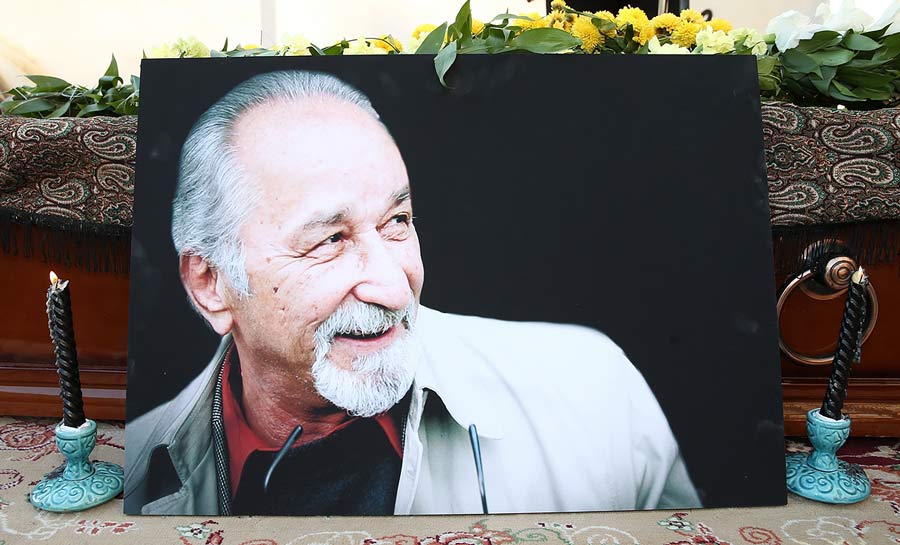
The commemorating for the late Jafar Vali, a prominent theater, cinema, and television actor, was held with the presence of a group of artists at the 924th “Bukhara Night.”
According to Artmag.ir, citing IRNA, the 924th night of the Bukhara Nights, titled “Jafar Vali Night” in memory of the prominent theater, cinema, and television actor, Master Jafar Vali, was held on Sunday, December 7, with the presence of veteran actors Ali Nasirian, Iraj Rad, Dariush Moaddabian, Reza Babak, Mehdi Mayamei, Nahid Moslemi, Javad Toosi, writer and cinema critic, Sara Abedi, director and producer, Ali Dehbashi, journalist, literary scholar, writer and editor of Bukhara and Samarkand magazines, and a group of artists in the Hall of Master Jalil Shahnaz, the Iranian Artists’ House.
Ali Nasirian, veteran theater actor and director, expressed his gratitude to the organizers of this event and honored the deceased artists, saying: “Among my contemporaries and those who worked together in the field of theater; Jamshid Mashayekhi, Ezzatolah Entezami, Mohammad Ali Keshavarz, Davud Rashidi, all passed away and I was the only one left.”
He stated his experiences and activities in the field of theater and performing arts, saying: “I started my activity in the field of theater in the 1930s. At that time, there were only two institutions; the Barbad Society led by Ismail Mehrtash and the Saadi Theater managed by Abdolhossein Noushin. I first started my activity in the Barbad Society. During this period, I collaborated with Jamshid Mashayekhi, Davud Rashidi, and Ezzatolah Entezami. In later periods, we staged theaters with artists such as Fahimeh Rastkar and Bijan Mofid.
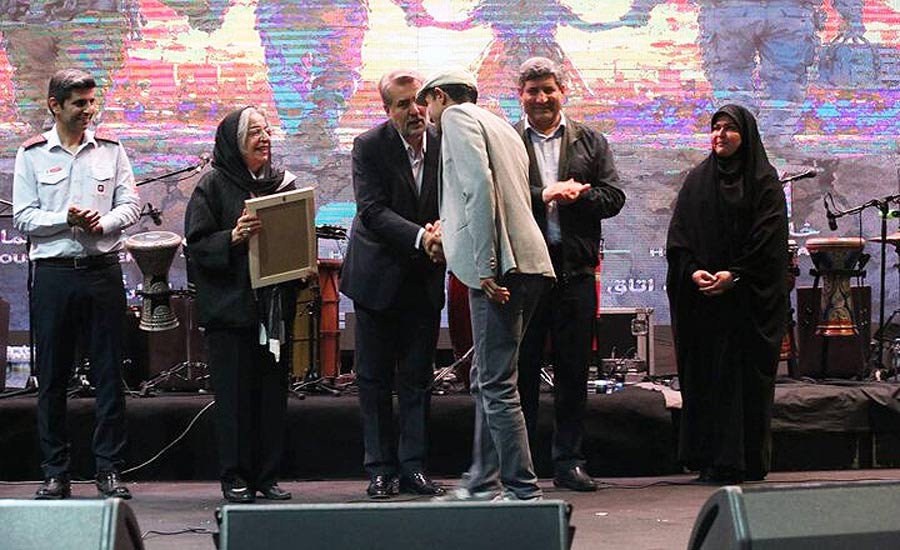
Ali Nasirian added: “In the meantime, we also collaborated with the Saadi Theater. During this collaboration, I met Jafar Vali. Educational, training, and acting and theater classes were held in this complex. The coup of August 19, 1953, also affected theater activities, and the Saadi Theater was burned down by protesters due to its connection with the Tudeh movement.” Nevertheless, activities in the field of theater and performing arts education continued by professors in conservatories.
We kept theater alive despite limitations
The veteran actor said: “At that time, we faced financial problems and a lack of facilities, including the lack of suitable halls and equipment, so we sometimes practiced theater in the ruins of the Sanglaj neighborhood. Despite these limitations, theater groups kept this art alive with creativity and effort.”
Referring to the activities of theater groups on Iranian television in 1960 and thereafter, he said: “At that time, the “People” group and Mr. Rashidi’s group performed various programs, and these programs played an important role in promoting theater at the national level, although there were limitations such as recording on black and white television and the lack of professional facilities.”
Ali Nasirian, referring to the role of figures and artists such as Jafar Vali in keeping the art of theater alive, said: Vali was an educated person, he had academic education in this field, he is one of the foundations of today’s Iranian theater, he had an awareness and passion for theater, even while he was sick, he thought about performing theater, the efforts of Vali and the deprivations we went through made Iranian theater reach this position today; we did not have the facilities or a place to perform, but nevertheless we moved forward and became a trend-setter.

Emphasizing the importance of collective work in theater, the veteran actor added: Theater is not an individual art, but the result of group effort. Literacy, education, research and investigation are key factors in the success and progress of theater art, and today’s Iranian theater needs educated and intelligent people who can be effective. Also, a director must have extensive knowledge and information in the fields of literature, art and culture in order to create an effective work.
Referring to the importance of education, experience and continuous effort, he said: We lost many personalities such as Entezami, Mashayekhi, Keshavarz, Rashidi, each of whom was an elite. It is difficult to replace exceptional people in art, because each generation and era has its own energy and talent. Nevertheless, in this era, we are witnessing creative and educated artists such as Homayoun Ghanizadeh who produce valuable and admirable works and are appreciated at international festivals.
Why was Jafar Vali’s personality ignored?
Javad Toosi, a writer and film critic, also mentioned the importance and role of cultural and artistic figures in this meeting and added: In the current atmosphere of society, due to the economic crisis, sanctions, and cultural stagnation, the presence of cultural centers such as Shab Bukhara has become more limited, and these limitations can weaken the motivation and morale of artists.
Referring to the role and status of Jafar Vali as the father of modern theater, he raised the question of why, despite his fruitful and influential career, this cultural figure has been ignored after the 1979 revolution?
Toosi stated: Cultural policymakers should have evaluated and appreciated Vali’s valuable career in the fields of theater, cinema, and television, but unfortunately, this has not happened. This inattention has led to the limitation of Vali’s activities, while he was capable of playing diverse and influential roles.
Comparing Iranian cinema with American cinema, this critic stated: In America, actors achieve fame and popularity after going through various stages, in the form of acting schools, but in our society, this process is limited and stereotypical due to the lack of a professional outlook and coherent structure.
Referring to the importance of the role of actors such as Jafar Vali, Akbar Zanjanpour, Behzad Farahani and Iraj Rad in the history of Iranian art, he emphasized: The lack of support and appropriate opportunities has caused these artists to emigrate or isolate.
Javad Toosi said: Iranian cinema also faces limitations, including the fact that films such as “Until Sunset”, the only work of Jafar Vali in the field of directing, have faced serious problems at the time of release and have not been able to be seen, while these works are significant in terms of content and artistic value.

The author added: Making portrait documentaries of cultural figures should be considered. Unfortunately, in the absence of the necessary support, many of these figures have been isolated and unmotivated, and our country’s cultural and artistic heritage is at risk of being forgotten. More support should be given to these individuals and the preservation of the country’s cultural and artistic heritage so that we can establish their true and worthy place in the cultural showcase of our society.
Points about the documentary “I Bikolah, Vali”
In another part of his speech about the documentary “I Bikolah, Vali” directed by Sara Abedi, Javad Toosi raised some points and stated: The intelligent selection of individuals and archival sources in the theater sector, such as Jamshid Malekpour and Dariush Moaddabian, for the production of this documentary is commendable. These choices have been able to create a suitable visual appeal for the audience and, in a way, contribute to the historical narrative of the character in question.
He stated: “However, the cinematic part of the work is very weak and the director has not been able to sufficiently address Jafar Vali’s cinematic periods. I suggest that a film critic be present to review Vali’s cinematic career and his important roles in this field and that we benefit from his words and opinions.”
Toosi added: “In the final part of the film, the director, using a clever cinematic ending, shows an image of a telephone conversation in Canada and the image of Jafar Vali reciting a dirge, which evokes a sense of lamentation and lamentation in the audience and, in a way, recalls Vali’s cultural and human heritage. This ending, with the dirge music and black and white image, strengthens the sense of reflection and deep respect for the character in question.”
Sara Abedi, director and producer of the documentary film “I Bikolah, Vali”, also stated in this ceremony: I expressed my basic and main words in this documentary, and I faced many difficulties and difficulties in making it, and finally, with all our strength and resources, I made the documentary “I Bekalah, Vali”, and a book with the same title has been published alongside it.
At the end of this meeting, the documentary film “I Bikolah, Vali”, directed and produced by Sara Abedi, was screened. This documentary is a portrait of Jafar Vali, one of the heirs of the theater and a pioneer of the National Theater. This project is accompanied by the research book “I Bekalah, Vali”, which was produced by Vazan Publishing under the management of Farzad Farahvashi.
Jafar Vali, an actor, theater director, and screenwriter, was born in 1933 in Tehran. He graduated in acting from the Faculty of Dramatic Arts at Tehran University. He began his professional acting career in the 1950s. Vali is one of the pioneers of national and Iranian theater, who performed lasting works in the 1950s and 1960s at Sanglaj Hall.
Many veteran actors began their careers with Vali and later became the standard-bearers of Iranian theater art themselves. Many prominent Iranian writers were also discovered and introduced to the artistic community by this director and actor, including Gholamhossein Saedi, and this acquaintance was the beginning of a close relationship that led to the creation of lasting works in the history of the golden age of Iranian theater. The mentality of Jafar Vali as a director and Gholamhossein Saedi as a writer was such that both of them were walking on the same path, based on an ideology and with a coherent intellectual structure.
Vali first appeared in the cinema in 1969 at the age of 36, and played a role in the film “Gav” directed by Dariush Mehrjui. Although the success of this work was not greater than his later significant works such as the series “Hezar Dastan” directed by Ali Hatami, it is considered a good experience for Vali and he experienced collaboration with artists such as Ezzatolah Entezami, Ali Nasirian, Jamshid Mashayekhi and Parviz Fannizadeh.
Vali has played roles in films such as “Bahar Dar Payiz” directed by Mehdi Fakhimzadeh, “Nakhoda Khorshid” directed by Naser Taghvai, “Payizan” directed by Rasoul Sadrameli. The film “Ta Ghorob” is Vali’s most important work in his directorial career. The artist died in 2016 due to lung disease and his body was buried in the Artists’ Plot of Behesht Zahra (PBUH).