
A writer and media activist has described the characterization in the works of the late Reza Amirkhani as so convincing that readers come to believe his fictional characters are real.
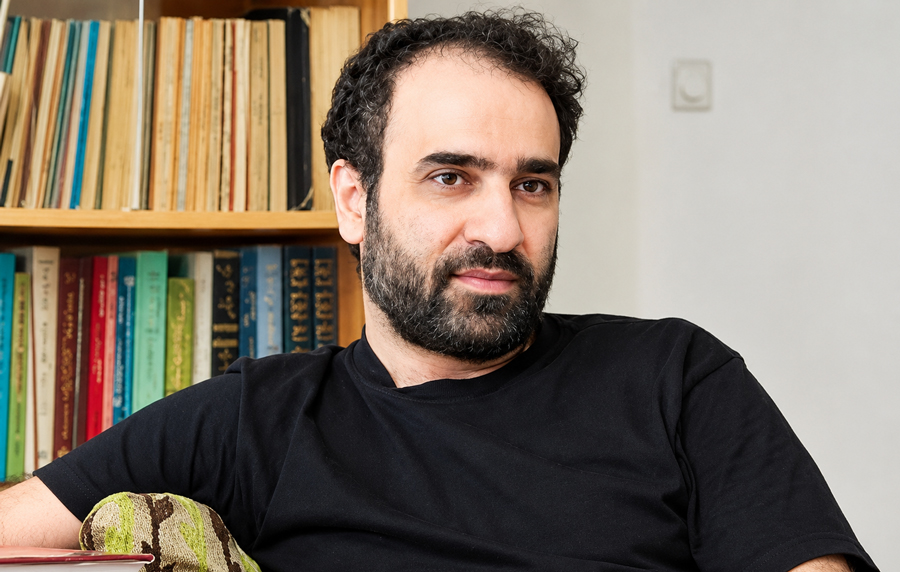
According to Artmag.ir quoting Mehr News Agency, Hamid Mohammadi, a writer and media activist, spoke about his acquaintance with Reza Amirkhani, which dates back to 1999. He said: “I first became acquainted with him through his novel Eramia. Later, after reading Man-e Ou (The Man of Him), I became more familiar with his fictional world and his writing abilities. One of Amirkhani’s most remarkable qualities was his power of visualization and his ability to create characters who, despite being fictional, seemed entirely tangible and real to readers.”
Referring to his acquaintance with Amirkhani in cultural and sporting circles, Mohammadi added: “In those years, we were connected through football and the magazine Keyhan Bacheha. We used to play football together.”
“I have many memories of him from that time. One of the most interesting concerns his trip to the United States. He travelled there wearing a black shirt for mourning during the month of Muharram. The trip lasted approximately 40 days, during which Amirkhani became familiar with various aspects of the lives of Iranians living in the United States, as well as the country’s cultural and social atmosphere.”



Mohammadi, referring to Amirkhani’s diverse experiences during this journey, said: “During that period, he visited a wide range of places and events, from a religious sermon by Ayatollah Javadi Amoli to performances and programmes by some Iranian singers living in the United States, particularly in Los Angeles. He spent part of that time living in a Chevrolet. In my opinion, these experiences and observations gave him a different perspective, which was subsequently reflected in his writing. The outcome of this journey was the book Bi Vatan.”
Referring to Reza Amirkhani’s travelogues, the writer and media activist said: “Works such as Janestan-e Kabulestan, about Afghanistan, and Nim-Dang-e Pyongyang, about North Korea, are among his outstanding travel books. This is particularly true of his account of North Korea, a country about which Iranian readers had very little information regarding people’s lifestyles, customs, food and cooking traditions. Amirkhani succeeded in presenting a different picture of the country, especially in an area that, I can confidently say, had rarely been explored in this way.”
He continued: “Amirkhanii had a very distinctive approach to travel in these accounts. He even spent ten days travelling in Sistan, accompanying the martyred leader of the Revolution. By a different approach to travel writing, I mean his particular style of narration. He does not simply say that we went to Afghanistan and this or that happened. Instead, before even reaching the destination, he also recounts the circumstances and events that led to the journey in the first place.”
To illustrate this characteristic, Mohammadi referred to a passage from Janestan-e Kabulestan, saying: “In the book, Amirkhani explains that they had initially travelled to Mashhad and then, following a simple suggestion, decided to set off for Afghanistan. He even mentions that they did not have enough money for the journey. This honesty in recounting details and his attention to the events leading up to a trip distinguish his writing from many other travelogues.”
Characters Who Seemed Real, Yet Never Existed
Comparing Amirkhani’s travelogues with other works written about Afghanistan, he added: “If we compare this book with travelogues written by other Iranian writers and poets about their journeys to Afghanistan, the difference in Amirkhani’s perspective and narrative approach becomes quite clear. In my view, he held an outstanding position in travel writing and succeeded in presenting the genre through a distinctive perspective and style.”
Mohammadi went on to discuss the impact of the novel Man-e Ou on him personally: “When I read this novel, its imagery and characters were so vivid and powerful that I imagined all those people actually existed in the real world. On the night I finished reading Man-e Ou, I was sleeping on the rooftop of our house, inside a mosquito net. The following day, I got on my bicycle and headed to the Khani Abad-e No and Takhti neighbourhoods to find Qandi Mosque and the other places described in the book, and to ask around about the characters.”
He continued: “The characters and the neighbourhood were portrayed so realistically and convincingly that I genuinely believed the people and places described in the novel existed. However, when I visited the neighbourhood, I discovered that many of those characters and settings had no real-world existence.”
Explaining how such convincing characters came to be created in Man-e Ou, the writer said: “The reason was that, before writing the novel, Reza Amirkhani had spoken extensively with his grandfather about that neighbourhood and its people. Drawing on his grandfather’s memories and accounts, he created characters who did not exist in the outside world, yet were so tangible and vivid within the story that readers could feel their actual presence.”
Emphasizing Amirkhani’s ability to create imagery and construct fictional worlds, Mohammadi added: “In my opinion, this was one of his most outstanding abilities as a novelist: he could create characters and settings that readers would readily believe in, to the extent that even after finishing the book, they might set out for that very neighbourhood in search of them.”
He also referred to Amirkhani’s other travel experiences, saying: “In addition to his journeys abroad, he also travelled extensively within Iran. One example was his trip to Sistan and Baluchestan in 2003, when he accompanied the martyred leader of the Revolution and spent approximately ten days on the journey.”
In conclusion, Mohammadi spoke about Amirkhani’s standing in travel writing and fiction: “I believe his distinctive perspective on travel and his ability to narrate details enabled him to attain an outstanding position in both travel writing and fiction. He did not simply recount the destination. He brought readers face to face with the people, circumstances, background events and details that gave his writing its identity and appeal.”
The editorial board of Artmag.ir, the bilingual portal for Iran’s professional artists, extends its condolences on the passing of this influential artist to the artistic community, his family and all those who learned from him.