
The short film Khalil opens in darkness through a sound based device: the resonance of a prayer that establishes the semantic world of the film before the image appears.
According to Artmag.ir, as the image emerges in the village of Shojaabad, we encounter a ritual that, in cinematic terminology, can be regarded as the dramatic point of departure: a funeral.
Khalil, a boy of about ten dressed in black, stands beside his father’s grave in a landscape suspended between the green of life and the yellow of decay. Contrary to conventional psychological expectations, his face is calm, with no visible sign of crying or distress. This unexpected stillness and calm create the first rupture between social reality and the world represented by the film.
There, he hears words that will determine his father’s fate after death. His mother and a girl named Rozhin, whose relationship with the family remains unclear until the end, are also seen silently around the grave, along with a small number of other women and men. The village Mamosta, the local religious figure, connects Rahim’s salvation to the forgiveness of the people. In his speech, he emphasizes divine forgiveness and the people’s pardon: if the people forgive Rahim, God will also take him to heaven.

These words plant a seed of doubt in Khalil’s mind and send him on an inner and outer journey to make certain of his father’s fate. Is my father a sinner? Have the people forgiven him? Will God forgive him?
This statement plants the seed of internal conflict in Khalil’s mind and transforms him from a passive mourner into an active seeker. In his search for an answer, Khalil turns to the institution of formal religion, represented by the Mamosta, as well as his family, school, and ultimately his own childhood imagination.
Khalil is a story about an attempt to touch the transcendent in a world where the strict rules of tradition cast a heavy shadow over the innocence of a questioning child.
Accompanied by his two friends, Sarkout and Fouad, Khalil goes from house to house and farm to farm, asking the villagers to forgive his father. At the same time, he shares his fundamental theological questions with his teacher and mother: Does God understand the Kurdish language? If people forgive someone, will God forgive him too?
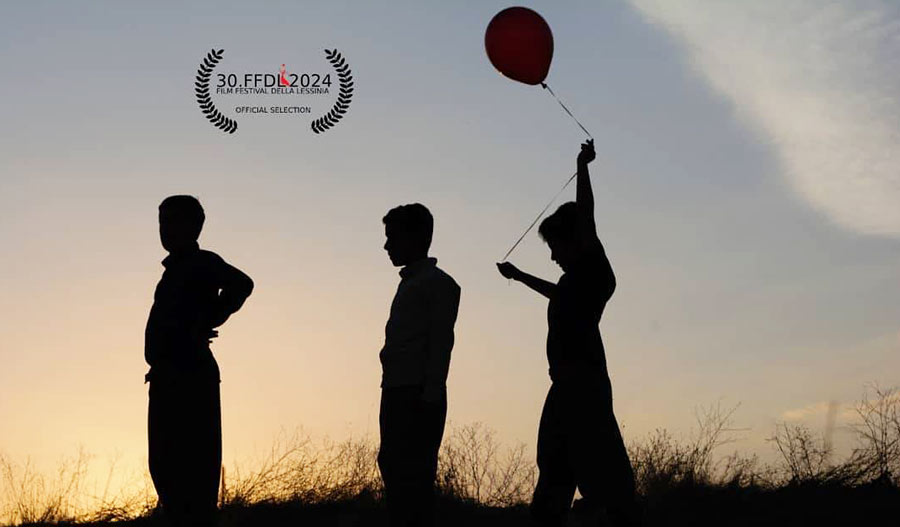
At the height of his search, Khalil writes a letter to God with the help of his teacher. He ties it to a red balloon and sends it into the sky. The letter contains a plea for forgiveness for his father and even for Rozhin’s father. The following morning, the balloon returns with an answer from God:
“Your father is in heaven with Rozhin’s father. Do not worry. I love you and I am watching over you.”
This event not only brings peace to Khalil, but also inspires the other children in the village to send their own letters to the sky on colorful balloons.
The film ends with a poetic image of balloons floating in the sky, symbolizing the connection between earth and heaven within a child’s worldview.
The short film Khalil, made in 2023 and written, directed, and produced by Payam Hosseini, is an independent Iranian film shot within the cultural context of Kurdistan. Hosseini, a graduate of the Iranian Youth Cinema Society in Sanandaj, had previously received awards for films such as Zara and Runner. Khalil also received two awards at its world premiere at the Lecce? festival in Italy, including Best Short film and a Special Award, and competed at festivals such as Osnabrück in Germany, Schlingel in Germany, and the Kurdish Film Festival in Hamburg, where it also received recognition.
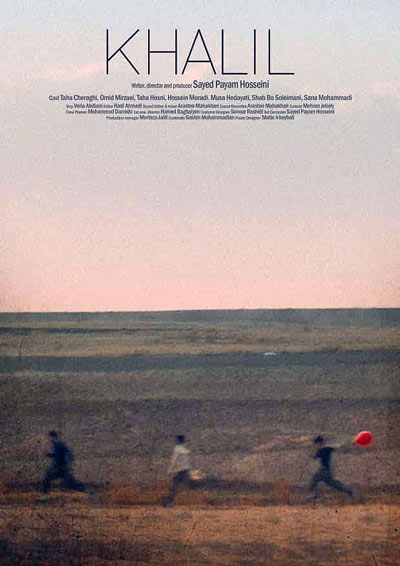
With a running time of approximately twenty minutes, the film belongs to the child centered drama genre and combines elements of social realism and folk theology.
I had heard about Khalil, its success at the Isfahan Children’s Film Festival, and its international awards, but I had not seen it. Mr. Hosseini generously made the film available to me so that I could watch it.
The central thesis of this analysis is an exploration of the paradox of faith as a means of overcoming grief in the world of childhood, where the boundaries between reality and the sacred become blurred and philosophical questions are answered with childlike simplicity. At times, however, the form of the film operates in tension with its content.
1. Theme and Worldview: Faith, Language, Childhood, and Death
The thematic core of Khalil rests on three central axes: death, faith, and language. The father’s death is not merely a biological event, but a theological question that brings the child into the realm of metaphysical inquiry.
The film attempts to represent faith not through formal religious law, but through a simple, human, and childlike experience. It explores the contrast between formal religion and intuitive faith, a faith based less on jurisprudence and ritual and more on dialogue, affection, and inner reassurance. It is not transcendent theological faith, but a tangible, childlike, and transactional form of belief.
In Khalil’s mind, God is not a distant entity, but a direct addressee, someone to whom a letter can be written. The film effectively shows how a simple religious statement can become an existential crisis for a child. The words of the religious figure plant the seed of doubt, while the institution of knowledge, represented by the teacher, opens a path toward direct communication with the transcendent.
One of the film’s strengths is the way it constructs the opposition between institutional religion and intuitive faith:
• The Mamosta represents formal religion, mediated through collective judgment. With an unusual calmness and a tone that sometimes resembles a Christian sermon, he turns heaven into a kind of social contract.
• The Teacher represents human and modern knowledge, opening the possibility of direct communication with the transcendent. His response to Khalil that “God understands all languages” opens a new path toward an unmediated faith.
Without becoming overtly ideological, this contrast moves the film beyond a purely religious narrative and toward a reflection on the sources of psychological reassurance available to a child.
The worldview of the film is based on Folk Theology, a concept that Martin Luther describes in The Freedom of a Christian (1520) as a popular understanding of God in transactional terms: heaven is not simply a divine gift, but the result of an exchange between human forgiveness and God’s mercy.
In the film, this perspective is expressed through the Mamosta, who presents the forgiveness of the people as a condition for Rahim’s entry into heaven and sends Khalil on a journey to collect that forgiveness. While reflecting popular religiosity in rural Kurdish communities, this approach adds an ideological layer: faith is not an abstract matter, but a social practice rooted in human relationships. God’s approval becomes an extension of the approval of the people with whom Rahim lived. If people are dissatisfied with his actions and words and refuse to forgive him, God will not forgive him either.
The subtle point here is that this transactional theology is expressed through the voice of a child who has just encountered the death of his father.
As Rudolf Otto explains in his concept of the sacred (1917), religious experience contains two dimensions, the fascinating and the terrifying.
In confronting death, Khalil finds God both fascinating, because God may save his father, and terrifying, because God may send his father to hell. This duality runs throughout the film. Ultimately, the film’s worldview is liberal in character: God is kind and accessible, and faith becomes a bridge between childhood and the sacred, transforming the terrifying mystery into childlike joy.
At the same time, the film’s worldview remains suspended between childlike simplicity and the oversimplification of complex religious concepts. The final answer to Khalil’s question is excessively certain and reassuring, as if the film avoids confronting the possibility of doubt, fear, or a crisis of faith. Although this choice is understandable within the film’s warm and humane tone, it reduces its philosophical depth.
From a sociological perspective, the film addresses the crisis of meaning in grief, where the father’s death represents not only emotional loss but also a threat to the child’s existential security.
As Ernest Becker argues in The Denial of Death (1973), human beings turn to cultural mechanisms such as religion to cope with the terror of death. In Khalil, this mechanism is realized through the letter to God and its return, offering the child ideological reassurance. Yet the absence of conventional mourning, particularly Khalil’s and his mother’s lack of visible grief, weakens this mechanism and suggests that the film does not fully capture the emotional realities of rural life. The fundamental question remains: Is this peace the result of faith, or a psychological need for certainty? The film depicts the narrow boundary between the two without completely falling into simplification.
Mother Tongue as Identity and Resistance
The film takes place in a Kurdish speaking village, and the characters speak Kurdish. This linguistic choice places the film among works belonging to Iran’s regional cinema. Yet an important ideological dimension lies in its depiction of linguistic identity: Kurdish children speak their mother tongue but are unable to read and write in it.
The scene in which Khalil cannot read the returned letter becomes a metaphor for “alienation at home”, a concept addressed by Edward Said in Orientalism (1978): the subordinate subject, in order to communicate with the official world, is forced to adopt the language of power.
The most intelligent thematic layer of the film is precisely the connection between faith and mother tongue. The classroom scene, where the teacher tells Khalil that God understands all languages, goes beyond a simple educational exchange and becomes a metaphorical statement about cultural identity. This theme reaches its peak at the end of the film, when Khalil cannot read the Kurdish response to his letter. It becomes a bitter yet intelligent comment on the rupture between mother tongue and the formal educational system.
The Kurdish child still needs an intermediary, the teacher, to communicate with his God, whom the teacher insists understands all languages, because the child cannot read his own mother tongue. This critical layer elevates the film from a purely emotional work to a social and cultural reflection and an exploration of identity.
Rozhin is mostly an observer, while the mother, in exaggerated silence and calmness, serves food and responds to Khalil’s fundamental questions with clichés: “Don’t think about these things. Eat your food.” This absence can be interpreted through Fatema Mernissi’s theory in Women and Islam (1991), which examines how patriarchal structures exclude women from the production and reproduction of meaning.
In the film, this exclusion occurs not through violence but through passive kindness, becoming especially visible when the mother asks Rozhin to prepare the bedding for her brother Khalil.
2. Drama and Narrative Structure: The Hero’s Journey Through a Maze of Ambiguity
From the perspective of dramatic structure, Khalil is a linear and episodic narrative built around the repetition of one action: questioning and seeking forgiveness. Khalil begins with the Mamosta, moves to his mother and teacher, asks the villagers for forgiveness, and finally writes a letter to God. On the surface, this movement can be compared with the Hero’s Journey.
The narrative structure of Khalil follows a classical three act structure, which Syd Field describes in Screenplay (1979) as the foundation of effective drama. Act One begins with the father’s death and the Mamosta’s speech, the inciting incident, followed by Khalil’s introduction and his fundamental question. This event removes Khalil from his ordinary world and sends him toward an adventure.
Act Two develops the conflict: Khalil collects forgiveness with his friends, asks his questions, and writes the letter. The decision to write the letter functions as the midpoint. The climax occurs when he releases the balloon, and the resolution comes with its return and Khalil’s relief. Yet the film is weak at the second turning point, the final crisis before the climax.
We might expect Khalil to face a crisis after sending the letter, such as uncertainty about whether it will arrive or a negative reaction from someone, but this never happens. This absence deprives the dramatic arc of necessary tension. Khalil’s dramatic arc moves from passive listener to questioner and finally to a messenger for the other children.
The structure maintains suspense through the child’s questions, but it contains few significant reversals. As Robert McKee emphasizes in Story (1997), a turning point should create a fundamental change in the values of the story. Here, the story’s values shift from fear of divine rejection to hope for mercy. This change is realized visually and concretely in the scene where the letter returns.
Rather than emerging naturally from actions and conflicts, the drama relies largely on explanatory dialogue. This becomes particularly evident in the children’s conversations about God, heaven, and hell, where the language and logic of the dialogue seem more mature than the characters’ ages and reveal the hand of the director.
As McKee suggests, drama takes shape when a character’s choices are placed under the pressure of conflict. That pressure is not sufficiently felt in Khalil.
In terms of genre, Khalil exists on the boundary between social religious drama and thematic children’s cinema, with a thin layer of magical realism. Yet it does not achieve complete balance in either direction. It is not complex enough to become a deeply developed social drama, nor sufficiently simple and emotionally direct to fully conform to the logic of children’s cinema.
The strong and universally relatable central idea is one of the film’s strengths. Yet the credibility of the narrative is one of its main challenges. The absence of visible suffering within the family and the lack of crying by Khalil and his mother at the funeral conflict with the psychology of grief. According to the Kübler Ross model of grief, involving denial, anger, bargaining, depression, and acceptance, one would expect at least some signs of distress, denial, or anger during the first days following the father’s death.
Khalil and his mother, however, display an almost unbelievable calm. Khalil even sticks his tongue out at Rozhin at the dinner table. This choice seems more directed than meaningful and weakens the realism of the film. If the film had established some background, such as a long illness or family conflict, this calmness after the death could have been justified.
Likewise, in the opening funeral sequence, the number of women, children, and men around the grave is very small, and there are no signs of crying or profound grief. Yet anthropological studies of Kurdish culture, including the work of Martin van Bruinessen, Kurdistan: A Divided Land? and related research, emphasize public mourning as an important element of cultural identity in Kurdish communities, particularly in rural areas. The complete removal of this element is therefore not simply a directorial choice, but also affects anthropological credibility.
In the dinner scene, the mother serves food with an unreal calmness. The celebrated French actress Simone Signoret wrote in her memoirs that real acting requires a real heartbeat. The mother’s calmness drains the emotional pulse of the scene. If she had attempted to remain composed despite her grief, the film could have transformed this contradiction into a dramatic layer. This is especially significant because throughout the film we do not know how many days have passed since the father’s death. The passage of time remains unclear, with no change of clothing or other chronological markers, weakening the film’s internal coherence.
Who Answered the Letter?
The question of who answered the letter, the teacher, the Mamosta, the mother, Rozhin, or the friends, is the film’s most important mystery. It creates suspense, but the absence of visual clues by the end turns it into an unproductive ambiguity.
If the respondent is the teacher or any of these
characters, the film arrives at a form of humanism, in which human beings, in the absence of a direct metaphysical answer, assume the comforting role of the divine.
If this ambiguity is intentional, the filmmaker has not provided sufficient clues to create genuine mystery. A brief shot of the teacher looking meaningfully at the balloon, or a smile suggesting that he has provided a human response to the child’s need, or even his unexpected passage in front of Khalil’s house on the morning when the balloon string is found tied to the plow, could have transformed the ambiguity into an interpretive layer rather than a source of confusion.
Although ambiguity can be a value in cinema, here the absence of visual clues turns artistic ambiguity into unexplained uncertainty. If the director had shown one of the characters briefly watching the balloon, Khalil’s faith would not have been undermined, but the logic of the story would have been strengthened.
There are two types of ambiguity:
• Desired ambiguity: when the film deliberately preserves a mystery and invites the audience to reflect.
• Undesirable ambiguity: when ambiguity results from weaknesses in the screenplay rather than from an aesthetic intention.
In Khalil, because the entire structure rests on the “answer from God”, ambiguity concerning the source of that answer destabilizes the thematic foundation of the film. If faith is supposed to be the subject of the film, the answer should remain supernatural. If human kindness, such as the teacher’s, is supposed to be the central theme, it should be shown. This duality is one of the screenplay’s most serious weaknesses. At the same time, the lack of sufficient visual clues makes the director’s attempt to impose a “sweet” ending too apparent.
The Question of Rozhin
Another of the film’s most serious gaps is the lack of a clear definition of Rozhin’s relationship with Khalil’s family. Rozhin is the screenplay’s greatest logical challenge.
In one scene, the mother tells Rozhin, “Prepare a place for your brother to sleep”, suggesting that she is Khalil’s sister. Yet in Khalil’s letter, we learn that Rozhin’s father died several months earlier and that she is not Khalil’s sister. If Rozhin is an orphan who has taken refuge in their home, why does no dialogue explain this? If she is not his sister, why is she present within the most intimate layers of this family? If Rozhin is the child of the mother’s other husband and therefore the maternal half sister of Khalil, there is no other evidence to support this, while the statement that Rozhin’s father died several months earlier also contradicts such an interpretation.
This ambiguity is not dramatic suspense, artistic ambiguity, or modern narrative uncertainty. It is a form of screenplay disorder and narrative confusion that causes the audience to experience logical confusion rather than emotional engagement, distancing them from the internal logic of the story world. The gap remains not as dramatic suspense but as an absence of information. It may add a layer of social meaning, perhaps referring to forms of tribal support in rural communities, but the lack of explanation leaves the audience suspended and ultimately confused.
Syd Field emphasizes in Screenplay (1979) that every character entering a story should either have a dramatic function or have an identity that is sufficiently clear. Rozhin loses both functions within a cloud of ambiguity.
The Hero’s Journey
The film’s correspondence with Joseph Campbell’s The Hero with a Thousand Faces (1949) and Christopher Vogler’s The Writer’s Journey (1992) is interesting. A striking but incomplete correspondence emerges:
• Ordinary World: Khalil’s life in the village with his father, mother, and Rozhin.
• Call to Adventure: The Mamosta’s statement about the condition for entering heaven, namely receiving people’s forgiveness.
• Refusal of the Call: Khalil’s initial doubt and his questions to his mother.
• Meeting the Mentor: The schoolteacher as a spiritual guide.
• Crossing the Threshold: The decision to seek forgiveness from the villagers.
• Tests: Encounters with the villagers, including the old woman, Kak Tofigh, Kak Jamil, and Kak Behrouz.
• Approach to the Cave: Writing the letter to God.
• Crisis: A sleepless night and a conversation with Rozhin.
• Reward: Receiving the letter and God’s response.
• Return with the Elixir: Sharing the news with his friends and inspiring the other children.
• Transformation and Freedom: The children sending their balloons into the sky.
This correspondence suggests that the screenwriter may have consciously or unconsciously drawn upon Campbell’s archetypal structure. Yet an important point is that the “wise old man”, or mentor, in this journey is the schoolteacher rather than the Mamosta.
This choice, while implicitly criticizing the traditional religious institution, presents modern education and new interpretations of religion as sources of liberation.
However, the film’s journey is incomplete at several key stages:
• The central test, confronting someone who has been hurt by Khalil’s father, never occurs. Everyone immediately forgives Rahim and speaks of his goodness.
• A genuine crisis never develops, and the transition from doubt to certainty is too simple and linear.
• The return with the elixir is more announced than dramatized. We hear about Khalil’s inner transformation rather than actually seeing it.
Characterization and Performance: Lively Children, Symbolic Adults
Khalil, played by Taha Cheraghi, is the core of the film. His motivation, the desire to be certain of his father’s salvation, is believable, and his movement from doubt to peace creates a clear character arc. His dialogue is natural, although at times it is more mature than his age, such as his questions about the language of God. This can be justified as a reflection of his religious environment, although the director’s hand remains visible.
Sarkout and Fouad, played by Omid Cheraghi and Taha Mohammadi, function as supporting characters and as the hero’s companions within the Hero’s Journey structure. Both serve a greater rhythmic function than a fully developed characterization. Sarkout is eager, persistent, and supportive, while Fouad is hesitant and repeatedly needs reminding.
Both children give natural performances and successfully communicate emotion. Yet some of their facial expressions and dialogue occasionally feel directed, such as the repeated line, “You always have work to do.” If moments of silence or unspoken looks had been added, the emotional depth would have increased.
Khalil’s performance in moments of silence is particularly strong. Yet his conversations with his friends, Sarkout and Fouad, sometimes sound excessively adult and writer driven. Fouad, who repeatedly talks about having work to do, seems almost like a piece of a puzzle forcibly placed by the director to control the rhythm.
Robert McKee emphasizes in Character (2021) that memorable characters contain tension between their conscious desires and unconscious needs. Khalil “wants” to know whether his father will go to heaven, but his deeper “need” may be something else: the need to accept death, preserve his father’s memory, and continue the experience of love. The film does not explore these hidden layers.
The mother, played by Shoubo Soleimani, is kind and patient but remains largely passive. She neither takes Khalil’s questions seriously nor participates in the central action of writing the letter. Her exaggerated calmness reduces the credibility of a recently widowed rural woman. If the mother had possessed hidden layers, such as her own religious doubts or a personal memory of the father, the film would have gained greater depth.
Rozhin is a mystery that the film not only fails to solve but actually makes more complicated. By the end, we know that she is not Khalil’s sister and that her father has also died, but we have no idea why she lives in their house. Is she his cousin? Has her mother also died? Is her mother the same woman as Khalil’s mother? Does she have no other family? This ambiguity deprives the character of dramatic function. Rozhin is both passive and mysterious, creating an emotional contradiction.
The Mamosta, played by Hossein Moradi, is one of the weakest elements of the film. From his clothing, a Persian style jacket and knitted cap rather than the full Kurdish attire traditionally associated with Mamostas in the region, to the tone and content of his speech, he bears little resemblance to Kurdish religious figures and does not fully correspond to the realities of Kurdistan. Everything suggests a superficial representation of Kurdish culture.
Dr. Seyed Mehdi Sajjadi writes in The Sociology of Religion in Kurdistan (2011) that the Mamosta in Kurdish culture is not merely a religious figure but also a symbol of identity, language, and resistance. The film, however, turns the Mamosta into a stereotypical Christian priest.
Anthropologist Nasser Fakouhi has also emphasized in his writings on Kurdistan that Kurdish religious figures, the Mamostas, generally wear complete local clothing and that their sermon style combines local dialect with religious Arabic.
This inconsistency removes the culturally knowledgeable viewer from the world of the film. If this estrangement is intentional, its function within the text is unclear. If it is unintentional, it suggests insufficient field research. Although it can be interpreted as an attempt to universalize the story, it reduces the film’s local authenticity and weakens its credibility for viewers familiar with the region.
The teacher, played by Mousa Hedayati, becomes the symbol of knowledge and the hero’s mentor, replacing the Mamosta. He is the one who wears Kurdish clothing and answers Khalil’s theological questions. He presents God as kinder and more linguistically inclusive than the official religious narrative. He gives Khalil “permission” to communicate with God in his mother tongue and ultimately reads the letter.
Although this character has a clear function, he lacks depth. We know nothing about his past, motivations, or even his name. At the end, we still do not know whether he wrote the response to Khalil’s letter and tied it to the plow facing the window in their yard or not. If the film had shown a moment of the teacher’s loneliness or his own doubts, the character would have become more layered.
Form, Aesthetics, and Genre: Visual Realism in the Service of Meaning
The film belongs to the genre of child centered drama with religious and realist elements, resembling Italian neorealist cinema while remaining rooted in an Iranian Kurdish context. Formally, it can also be placed within magical realism, where an imaginary element, receiving a letter from God, is accepted within the framework of ordinary rural life. The mystery of the responder remains unresolved until the end without creating doubt.
The cinematography by Voria Golzarian creates a natural aesthetic through wide compositions of fields and mountains. The green and yellow colors of summer and autumn symbolize transition and the opposition between life and death, represented in a poetic manner.
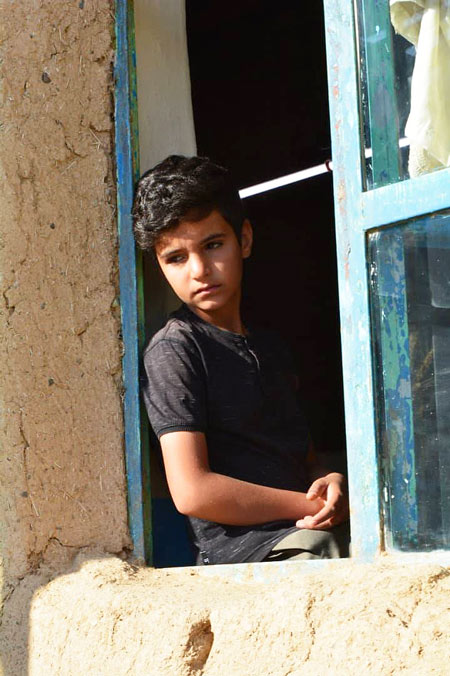
The nighttime shot of Khalil alone beside the window, with soft light falling on his face from outside, captures the child’s existential loneliness. The final shot shows the children standing on a hill and releasing the balloons. This symbolic image becomes the culmination of hope and collective solidarity.
Natural light and cool colors at night reinforce the sense of loneliness, although greater contrast in emotional scenes, such as the return of the balloon, could have strengthened the visual impact.
The rural production design is authentic in many respects, with mud brick houses and a kerosene Aladdin lamp. Yet details such as new pots and glasses reduce credibility, making them appear as though they were used for the film only once. The Aladdin lamp, appearing in a season where signs of harvest and the warmth of summer and early autumn are evident, feels more like an imposed prop than an element of real life. Greater attention to production design details would have given the film’s realism greater depth.
Nevertheless, in some shots, such as the nighttime image of the village, which looks more like a photograph than a cinematic shot, form loses its dramatic function and becomes decorative.
The film’s lighting follows a progression from darkness toward light:
• Opening sequence: soft morning light, representing the beginning of the question.
• Interior scenes at home: limited and dim light, representing ambiguity and doubt.
• School sequence: bright natural light, representing awareness and intellectual illumination.
• Final sequence: brilliant sunlight over the hill, representing hope and liberation.
This progression of light corresponds with Khalil’s character arc and contributes to the film’s thematic communication.
The film’s color palette is largely based on three
Symbolic colors:
• Yellow: yellow fields, symbolizing death, the autumn of life, and transition.
• Green: patches of green among the yellow, symbolizing hope and continuing life.
• Red: the red balloon, symbolizing love, faith, and communication with the sacred.
The actors’ clothing, however, does not participate in this symbolic color structure.
The editing by Hadi Ahmadi has a slow rhythm, with smooth cuts between day and night, although it occasionally becomes inconsistent, as in the unnecessary nighttime shot of the village. The film’s rhythm is dynamic and coherent in the children’s sequences, but becomes slow and prolonged in interior scenes such as dinner.
The repetition of the forgiveness scenes, involving the old woman, Kak Tofigh, Kak Jamil, and Kak Behrouz, creates dramatic monotony despite visual variation.
If the filmmaker had transformed one of these encounters into a genuine challenge, such as someone who had actually been hurt by Khalil’s father, both the rhythm and dramatic intensity would have improved.
There is also a jump in the sequence involving Rozhin and Khalil sleeping. Its connection with the preceding scene is inconsistent. It seems to correspond more naturally with the dinner table scene, yet the narrative has moved away from it, weakening editorial coherence.
The music by Artin Hamedi is minimalist and reaches its emotional peak when the balloons are released, creating a sacred atmosphere. If the music had been built more extensively around environmental sounds, such as the wind across the fields, it might have achieved greater authenticity.
The sound design by Aristu Mofakheri is natural, incorporating crickets, barking dogs at night, prayer, and children’s voices. Form corresponds with content. The realism of rural life, including the sound of water as the children run, creates a tangible and lived environment. The main weakness in the sound design is the absence of environmental sound in some interior scenes, which makes those spaces feel somewhat studio based.
Final Evaluation and Conclusion: A Promising Place in Iranian Children’s Cinema
Khalil, with its engaging and universally relatable central idea, a child’s question about the fate of his father after death and the use of childlike faith as a refuge from grief, along with its natural images of Kurdistan, its symbolic and moving ending with colorful balloons released into the sky, and its intelligent commentary on mother tongue and the educational system, stands among thought provoking works capable of engaging both general and specialized audiences.
The film succeeds through the natural performances of the children, its visually striking atmosphere, and minimalist music in creating a world that is tangible yet poetic.
Khalil occupies a place in Iranian short cinema alongside films such as The White Balloon, directed by Jafar Panahi in 1995, which also portrays a child searching for something tangible. Both films use the balloon as a symbol of hope, but Khalil is more innovative in its religious and spiritual dimensions.
In The White Balloon, the girl tries to obtain a goldfish and loses her money, symbolizing the everyday challenges of childhood in urban Tehran. In Khalil, the red balloon becomes a vehicle for spiritual discovery. The child in Khalil is searching for metaphysical certainty, while institutional religion becomes the starting point for his questions.
A comparison can also be made with The Red Balloon, directed by Albert Lamorisse in 1956. The French film, which won the Academy Award for Best Original Screenplay, follows a boy who befriends a living balloon that follows him, becoming a metaphor for loneliness and friendship. Khalil reverses this idea.
The balloon is not alive, but instead becomes a medium of faith and an intermediary for communication with God. The setting is rural Kurdistan rather than postwar Paris. Yet both films focus on the possibility of miracles within the world of childhood. This localized and religious reinterpretation of the balloon is one of the film’s strengths. Khalil connects imagination with faith and transforms it into a social experience.
The weaknesses of Khalil lie in its credibility and unresolved narrative ambiguities, including the uncertainty surrounding Rozhin’s relationship to the family, the unclear passage of time following the father’s death, and the source of the letter’s response. These weaknesses are compounded by occasionally unnatural dialogue, superficial characterization of the adult figures, including the mother, Mamosta, and teacher, the absence of conventional mourning, the exaggerated calmness of the characters, the inconsistency of the Mamosta’s clothing and speech, and the absence of villagers around Khalil’s father’s grave in a way that does not fully correspond to the cultural realities of Kurdistan.
The dramatic monotony of the repeated forgiveness scenes and the lack of a genuine crisis or effective suspense also reduce the film’s impact, but they do not destroy the work as a whole.
The film’s presence at international festivals demonstrates its cinematic significance. It offers a universal message about access to God that can engage general audiences emotionally and specialized audiences analytically. Its lasting quality lies in reminding us that faith, even within ambiguity, can provide comfort.
If the film had treated grief, local details, and dramatic logic with greater precision, and if its structural weaknesses had been addressed, particularly through stricter attention to behavioral credibility and dramatic logic, it could have become a masterpiece and potentially entered the ranks of the notable works of Iranian children’s cinema.
Despite its shortcomings, Khalil remains a thought provoking film that forces the viewer to consider one of the simplest yet deepest questions of childhood:
Can we speak directly to God?
Ultimately, Khalil is a film about faith in an age of doubt, about a child who tries to solve the greatest mystery of existence through the language of childhood.
The film reminds us that questioning the fate of those we have lost is not merely a theological concern, but a universal human need. Although the film has certain weaknesses in execution, the sincerity of its vision and the purity of its central idea transform it into a work capable of establishing a deep connection with its audience.
This is precisely the quality that keeps Iranian short cinema alive and dynamic, even with all its limitations.